
 1 month ago
17
1 month ago
17

content, reviewed by leading industry experts and seasoned editors. Ad Disclosure
On-chain data shows the Bitcoin Hashrate has continued to decline, with its 7-day average value hitting lows not seen since early September.
Bitcoin Hashrate Has Been Sliding Down
The Bitcoin “Hashrate” refers to a measure of the total amount of computing power that the miners as a whole have connected to the network. It’s denoted in units of hashes per second (H/s) or, more practically, in exahashes per second (EH/s). This indicator can be useful for gauging the sentiment shared by the miners. Growth in the network Hashrate can signal that this cohort is either responding to a period of profitability or expanding in anticipation of future price action. On the other hand, a decline can signal a weakening of sentiment.
As the chart below from Blockchain.com shows, the 7-day average value of the Bitcoin Hashrate has been following the latter kind of trajectory in recent months.
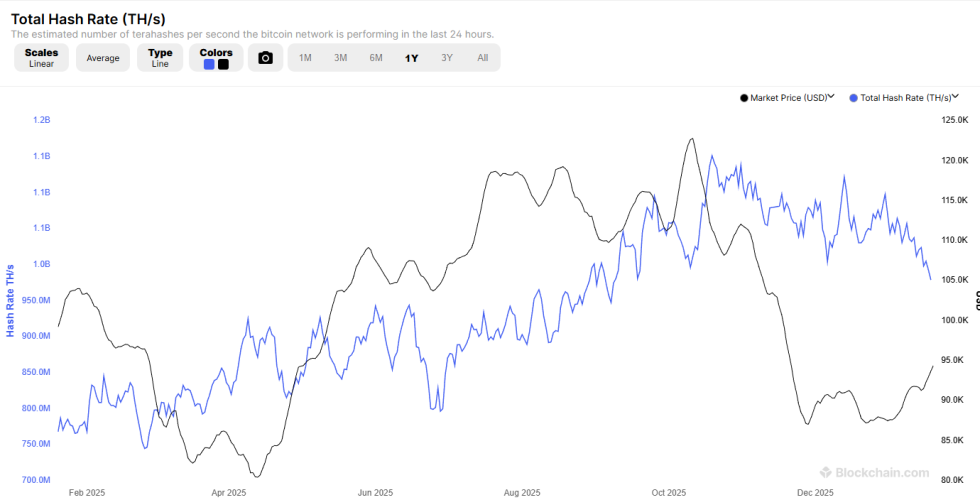
The Hashrate set a new all-time high (ATH) in mid-October, but miners moved to decommissioning power as the cryptocurrency’s price went through its bearish shift in that month. Recently, BTC has shown some recovery, but that doesn’t appear to have changed opinion among the miners, as the metric’s value has only continued to go down.
Currently, the 7-day average Bitcoin Hashrate is sitting at 978.8 EH/s, which is the lowest level since the first half of September. The recent low levels are on a path to affect another BTC-network-related metric: the Difficulty. The Difficulty is a feature built into the blockchain that controls how hard it is for miners to mine blocks. This metric automatically changes its value about every two weeks based on how fast miners have been performing their duty since the last adjustment.
Satoshi coded in a simple rule for the network to follow: block time should converge to 10 minutes. If miners take an average time faster than this to find a block, the chain raises its Difficulty in the next adjustment. Similarly, a decrease instead happens if the validators are slower at their job.
As miners have reduced their computing power over the last few months, their pace has been going down, and the network has been adjusting the Difficulty lower.
With the Hashrate decline only continuing recently, the network is once again moving toward another relaxation in Difficulty, as data from CoinWarz suggests.
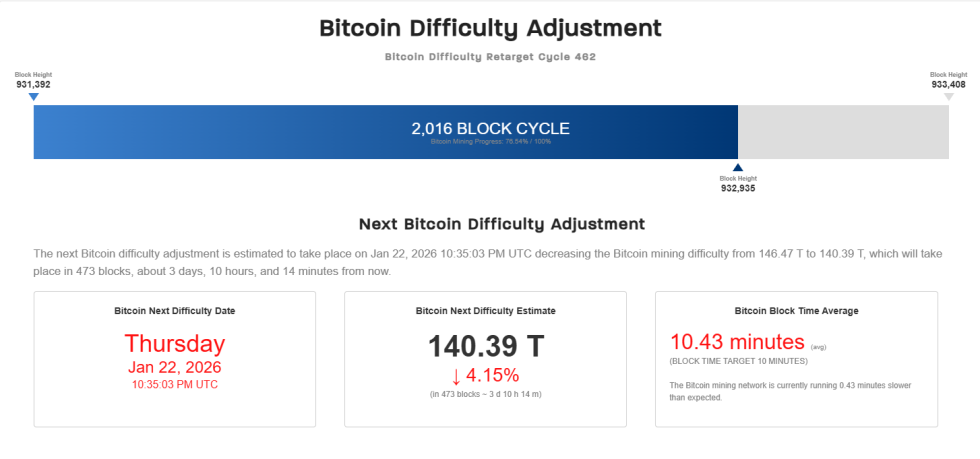
The average Bitcoin block time has stood at 10.43 minutes since the last adjustment, which is notably slower than the standard rate. As a result, the network is estimated to reduce the Difficulty by 4.15%.
With the adjustment still being a few days away, however, this figure could change depending on whether miners expand or decommission in the coming days.
BTC Price
At the time of writing, Bitcoin is floating around $93,000, up 2.5% in the last seven days.
Featured image from Dall-E, chart from TradingView.com
Editorial Process for bitcoinist is centered on delivering thoroughly researched, accurate, and unbiased content. We uphold strict sourcing standards, and each page undergoes diligent review by our team of top technology experts and seasoned editors. This process ensures the integrity, relevance, and value of our content for our readers.















 English (US) ·