
 1 month ago
24
1 month ago
24

content, reviewed by leading industry experts and seasoned editors. Ad Disclosure
The crypto market has started the week under pressure as macroeconomic uncertainty and trade tensions unsettled investors, briefly pushing Bitcoin below $65,000 and driving a surge in online panic signals. The latest decline has closely followed global economic headlines rather than crypto-specific factors.
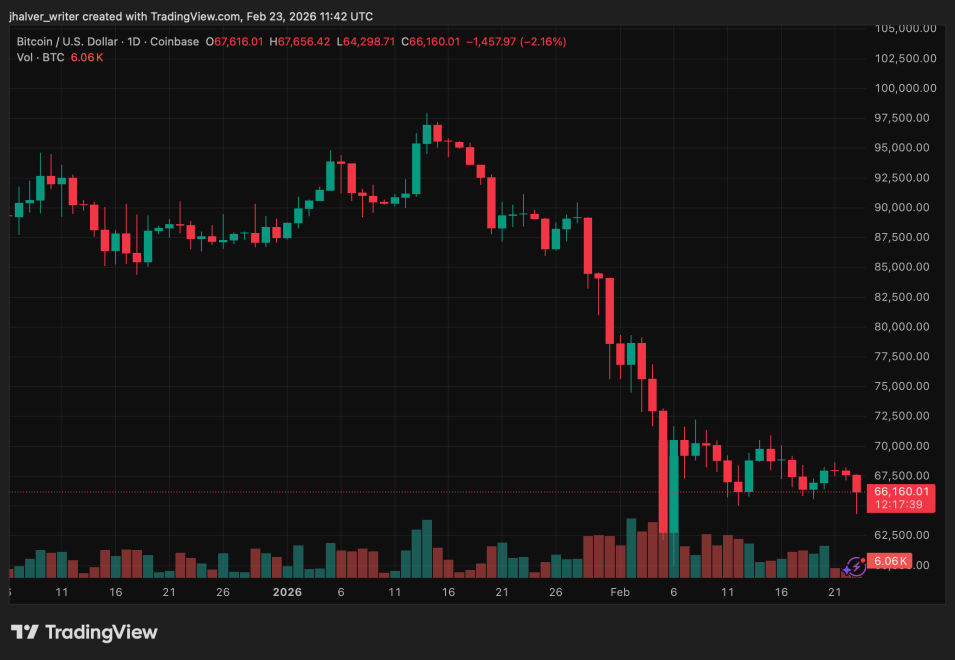
On Feb. 23, Bitcoin dropped to nearly $64,400 within hours, dragging major altcoins lower and wiping billions from total market value. The move coincided with escalating tariff concerns after U.S. President Donald Trump announced an increase in global import tariffs to 15%, amplifying fears of slower economic growth.
Fear Spikes as Retail Sentiment on Bitcoin (BTC) Deteriorates
Retail sentiment has weakened sharply as prices struggle around $65,000, with fear increasingly visible across market indicators. Online search behavior reflects growing anxiety, as data from Google Trends shows a record surge in searches for “Bitcoin to zero.”
Technical indicators show Bitcoin (BTC) struggling to maintain key support levels amid heightened selling pressure. Spot trading volumes dropped by nearly 59%, limiting liquidity and amplifying price swings. Derivatives markets also reflect caution: open interest fell to $19.5 billion, roughly half of January’s peak.
Price charts indicate further downside if support near $64,000 fails, with $60,000 as the key lower target. The 20-day moving average around $68,278 and the lower Bollinger Band near $64,098 show range-bound pressure, while mild outflows and clustered leveraged longs between $64,090–$64,536 could trigger liquidations.
Macro Shocks Weigh on Crypto Markets
Analysts linked the sell-off to a combination of weakening economic indicators and risk-off sentiment. U.S. housing data showed declining pending home sales, while currency markets reacted to expectations of tighter policy from the Bank of Japan, strengthening the yen and prompting global funds to reduce leverage.
Similarly, whale activity added pressure. On-chain data showed large holders moving coins onto exchanges, a signal often associated with selling. Spot trading volumes also dropped significantly, suggesting limited liquidity to absorb sudden moves.
The broader market followed Bitcoin lower. Ethereum fell roughly 5%, while other major tokens posted losses between 3% and 8%. Additional attention came after Ethereum co-founder Vitalik Buterin sold millions of dollars worth of ETH, reinforcing concerns about near-term supply pressure.
Market participants now view the $60,000 level as a key support zone. Analysts warn that a sustained break below it could trigger large liquidations, while recovery above the mid-$60,000 range may stabilize sentiment.
Cover image from ChatGPT, BTCUSD chart from Tradingview
Editorial Process for bitcoinist is centered on delivering thoroughly researched, accurate, and unbiased content. We uphold strict sourcing standards, and each page undergoes diligent review by our team of top technology experts and seasoned editors. This process ensures the integrity, relevance, and value of our content for our readers.
















 English (US) ·