
 1 month ago
33
1 month ago
33
While the market is in a precarious position with both BTC and ETH unable to flip their immediate resistances into support, Ethereum network activity shows that daily active addresses surpassed 700,000 in February 2026, more than the peaks recorded during the 2021 bull market.
ETH is down roughly 30% over the past six months, sitting near the $2,000 level even as the network processes work at a historic scale.
The gap between what Ethereum is doing and what ETH is worth has rarely been wider.
EXPLORE: Best New Cryptocurrencies in 2026 – Recently Launched Coins & Investment Watchlist
Ethereum Network Activity: Let’s Look at the Data
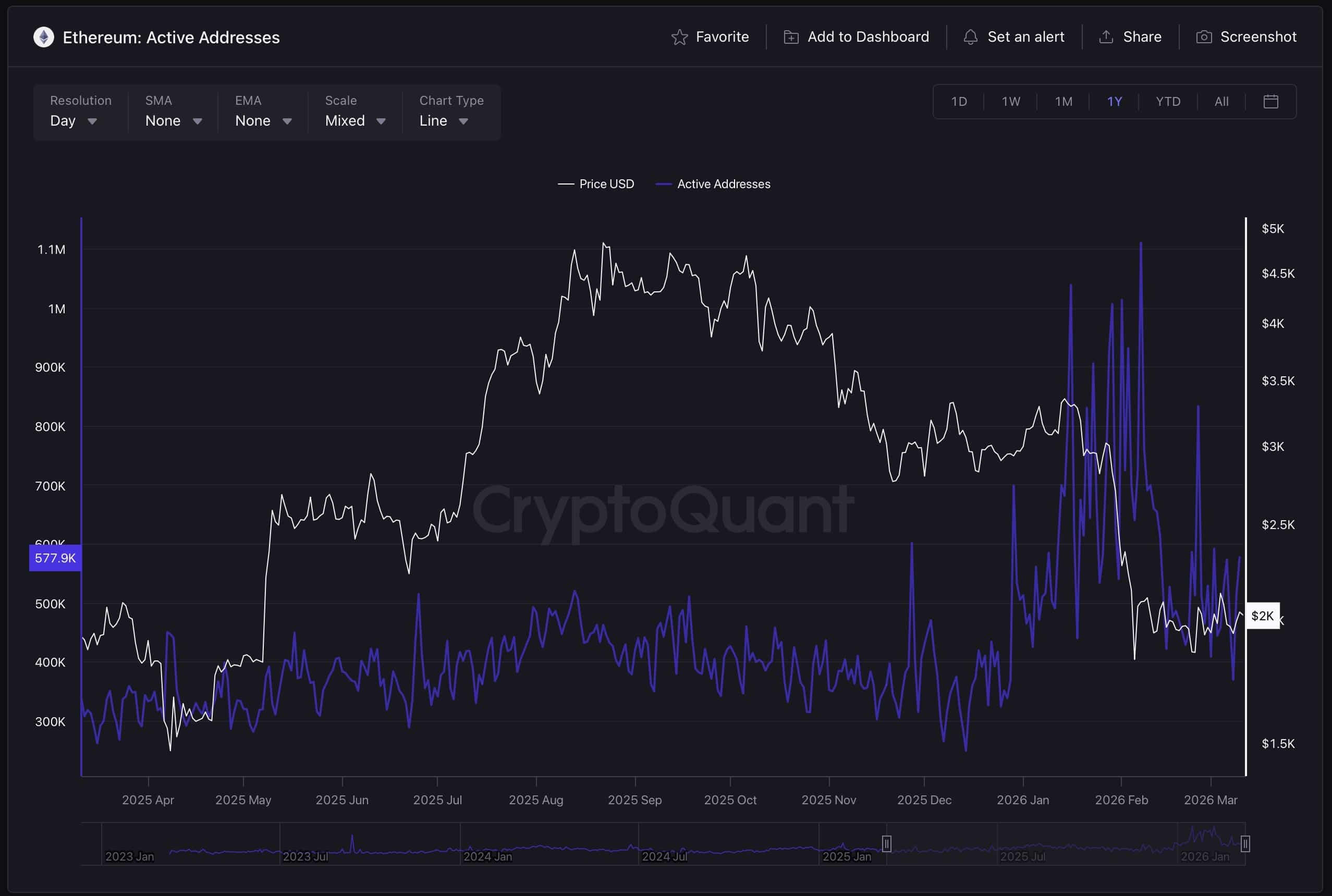
Ethereum Network Activity Active Addresses Source: CryptoQuant
Smart contract calls topped 40 million per day in February, and token transfers driven by internal contract interactions also set records, per the CryptoQuant report. The firm attributed the surge to broad adoption across decentralized finance, stablecoins, and automated protocol activity rather than a single catalyst.
Daily active addresses averaged 837,200 on a 30-day moving average, up 82% from five years ago and approximately 1,100% from a decade prior. New wallet creation reached 284,800 per day, a 64% increase from five years ago. Over 37.7 million ETH is currently staked, reducing circulating supply while liquid staking protocols maintain user access to those funds.
DISCOVER: What is the Next Crypto to Explode in 2026?
ETH Price Analysis: Ethereum Network Activity And Price Divergence
None of those figures has translated into price support. ETH’s one-year change in realized capitalization has turned negative. Ethereum is moving to trading venues at a faster rate relative to Bitcoin: a pattern consistent with elevated selling pressure.
CryptoQuant analysis showed recent data clustering at high activity levels but relatively low price levels, suggesting that incremental usage growth now carries less explanatory power for ETH’s valuation than it did in prior cycles. In both 2018 and 2021, rising on-chain activity coincided with price rallies. That relationship has weakened materially.
Complicating the picture further, a large Ethereum whale has been offloading substantial ETH holdings during this same period of peak network activity, adding downward pressure while usage metrics climb.
Data from DefiLlama shows Ethereum generated roughly $10.3 million in transaction fees over the past 30 days, placing it third behind Tron at nearly $25 million and Solana at approximately $20 million. Base, Coinbase’s Ethereum layer-2 network, generated roughly three times Ethereum’s protocol revenue over the same period.
The success of Ethereum’s own infrastructure is, in part, cannibalizing its base layer economics.
DISCOVER: 10 Potential Coinbase Listings in 2026
Can On-Chain Strength Finally Force a Price Realignment?
A meaningful recovery in ETH would likely require capital flow dynamics to reverse. Specifically, exchange outflows are accelerating, and realized capitalization is returning to positive territory. Protocol-level catalysts on Ethereum’s 2026 roadmap, which emphasize evidence-based scaling alongside continued L2 growth, could provide a narrative anchor if delivered on schedule.
The downside risk is that fee revenue stagnation persists, and the L2 fragmentation dynamic deepens without a mechanism to redirect value back to the base layer. If stablecoin settlement volumes and DeFi TVL, which peaked above $56 billion during the week of March 2–8 before easing, begin to soften alongside prices, the activity-driven bull case loses its remaining support.
Record usage without fee capture and without capital inflows is a different kind of record than Ethereum’s proponents were anticipating. Whether the market eventually prices the infrastructure or continues pricing the flows is the question 2026 may finally answer.
Disclaimer: Coinspeaker is committed to providing unbiased and transparent reporting. This article aims to deliver accurate and timely information but should not be taken as financial or investment advice. Since market conditions can change rapidly, we encourage you to verify information on your own and consult with a professional before making any decisions based on this content.

Daniel Frances is a technical writer and Web3 educator specializing in macroeconomics and DeFi mechanics. A crypto native since 2017, Daniel leverages his background in on-chain analytics to author evidence-based reports and deep-dive guides. He holds certifications from The Blockchain Council, and is dedicated to providing "information gain" that cuts through market hype to find real-world blockchain utility.
















 English (US) ·