
 4 weeks ago
26
4 weeks ago
26
Jensen Huang is making a bet that patience pays off in geopolitics. The Nvidia CEO is publicly framing China as a long-term growth engine for the company, even as US export restrictions have effectively locked Nvidia out of selling its most advanced AI chips there.
Huang’s comments, made on May 23 following a US business delegation trip to Beijing earlier in the month, position the Chinese market as part of a broader $200 billion opportunity in data centers and CPUs. The estimated long-term prize specifically in China: roughly $50 billion.
The Beijing trip and what followed
Huang was part of a US business delegation led by President Donald Trump that visited Beijing from May 13 to 15. The trip was apparently productive enough for Huang to express optimism about the future of US AI chip access in China during a Bloomberg interview on May 18.
Nvidia has, by Huang’s own admission, “largely conceded” its advanced AI chip segment in China to Huawei. Still, Huang emphasized Nvidia’s 30-year commitment to China and its established customer relationships.
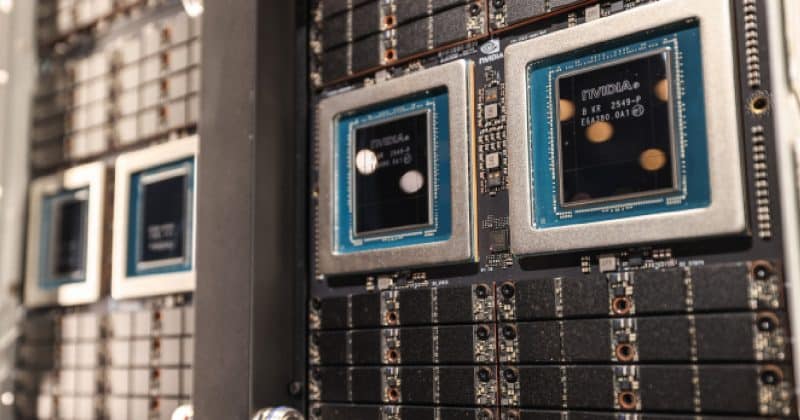
In the meantime, Nvidia has been developing compliant chip variants like the H20 and H200 specifically designed to thread the needle of US export controls.
The revenue reality
Before the export controls tightened, China accounted for approximately 13% of Nvidia’s total revenue in fiscal year 2025. That translated to roughly $17.1 billion.
The current situation means minimal sales of high-end AI chips to Chinese customers. Nvidia’s compliant chip variants can partially offset the loss, but they’re not a one-for-one replacement for the revenue that advanced chips generated.
Huawei fills the vacuum
While Nvidia waits, Huawei has stepped into the gap left by US export controls, offering local alternatives to Nvidia’s advanced AI chips. Huang’s acknowledgment that Nvidia has conceded this ground is unusually candid for a CEO.
What this means for investors
For anyone holding NVDA or considering a position, Huang’s comments reveal a company playing a long game with significant uncertainty baked in. The $50 billion long-term opportunity in China is a compelling number, but it comes with a massive asterisk: US-China tech relations need to improve materially before Nvidia can capture a meaningful share of it.
The development of export-compliant chips like the H20 and H200 shows Nvidia isn’t just hoping for policy changes. It’s building products that work within current constraints while maintaining a foothold in the market.
Disclosure: This article was edited by Editorial Team. For more information on how we create and review content, see our Editorial Policy.








 English (US) ·