
 1 month ago
13
1 month ago
13
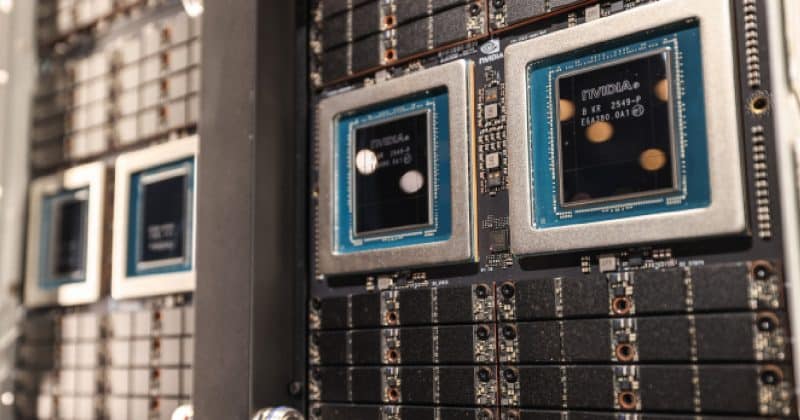
Nvidia, the company that built its empire on graphics processors, is now coming for the CPU market with the kind of ambition that should make Intel and AMD deeply uncomfortable.
The company is projecting roughly $20 billion in standalone CPU revenue for 2026. For context, that’s nearly the size of AMD’s entire annual revenue.
The unbundling strategy
The strategy centers on two chip families. The Grace CPU, which is already shipping, and the upcoming Vera CPU, which is expected to power CPU-only servers starting in 2027. Both are built on Arm architecture, positioning Nvidia as a direct competitor to the x86 incumbents that have dominated data center computing for decades.
A multiyear partnership with Meta is the clearest signal of where this is heading. The deal includes deployment of standalone Grace CPUs and plans for Vera CPU-only servers.
The trillion-dollar backdrop
CEO Jensen Huang has pegged cumulative AI compute demand at $1 trillion from 2025 through 2027. That figure was revised upward from a previous forecast of $500 billion.
Nvidia’s fiscal 2026 revenue landed at $215.9 billion, a 65% increase year-on-year. The vast majority of that growth came from data center AI systems.
Some analysts have gone so far as to suggest the Meta partnership could ignite a “CPU supercycle,” driven by increasing demand for discrete data center processors.
Why this matters for investors and the broader market
For Intel, this is an existential threat layered on top of existing existential threats. Intel has been losing data center market share to AMD for years, and now Nvidia is entering the ring with an Arm-based alternative that comes with the strongest brand name in AI computing.
AMD has been the scrappy challenger gaining ground in data center CPUs with its EPYC line, but Nvidia’s entry means AMD is now fighting a two-front war: defending its GPU market share against Nvidia’s dominance while simultaneously protecting its CPU gains from Nvidia’s new offensive.
The risk worth watching is execution. Nvidia has never been primarily a CPU company, and scaling a processor business to $20 billion in revenue requires manufacturing capacity, supply chain reliability, and enterprise sales relationships that differ meaningfully from its GPU playbook. The Arm architecture bet also carries platform risk: while Arm-based data center chips have gained traction (Amazon’s Graviton being the prime example), x86 still commands the overwhelming majority of installed server infrastructure.
Disclosure: This article was edited by Editorial Team. For more information on how we create and review content, see our Editorial Policy.












 English (US) ·