
 1 month ago
29
1 month ago
29
Ray Dalio's Apr. 9 TIME essay carries a geopolitical surface and a monetary argument underneath.
Dalio explicitly writes that his indicators point to a simultaneous breakdown of the monetary order, some domestic political orders, and the geopolitical world order.
The Iran conflict is the immediate trigger, but the structural claim below that is that investors expect conditions to stabilize quickly, underpricing the depth of the transition already underway.
Dalio's July 2025 TIME essay “Defending the Value of Money” argued that the dispute between President Donald Trump and Fed Chair Jerome Powell was fundamentally about the value of money.
When debt burdens grow too large, the classic response is to push real rates down and devalue currency.
In that same essay, he noted the dollar had fallen roughly 27% against gold and 45% against Bitcoin since the prior summer.
His January 2026 LinkedIn post argued that the monetary, domestic political, and international geopolitical orders were all moving through a single Big Cycle, with the current phase representing the pre-breakdown transition.
Dalio's April warning is another chapter in that argument.
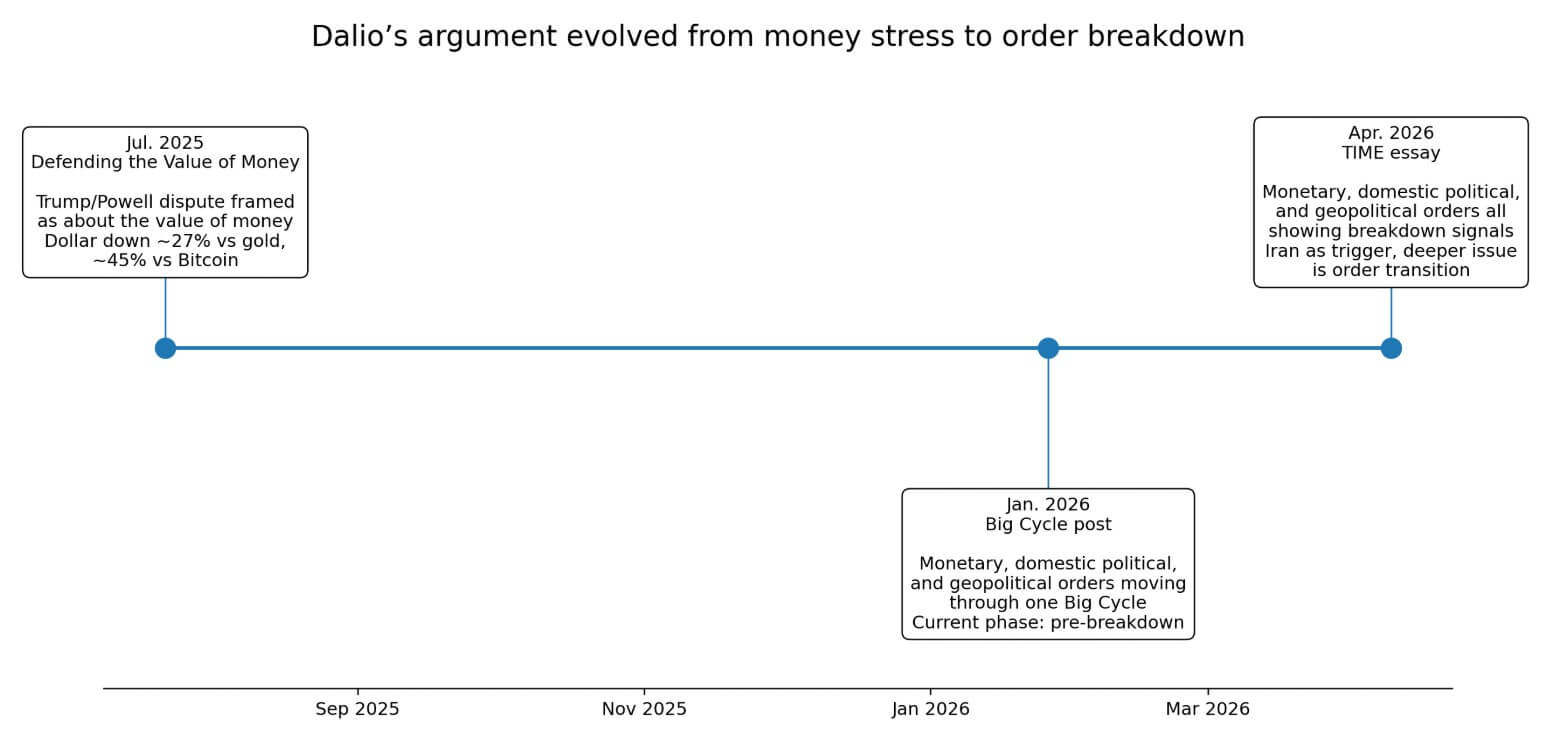 A timeline charts three Dalio essays from July 2025 to April 2026, tracing his argument from dollar devaluation through Big Cycle pre-breakdown to full monetary and geopolitical order collapse.
What the breakdown means for hard money
Once the frame moves from war shock to monetary-order transition, investors should start questioning which assets retain value as debt instruments appear less reliable and fiat systems look more politically exposed.
In a June 2025 LinkedIn essay, “How Countries Go Broke,” Dalio laid out the allocation logic for holding underweight debt assets, an overweight in gold, and a small amount of Bitcoin.
In an October 2025 TIME essay titled “Gold Is the Safest Money,” Dalio made the hierarchy explicit, describing gold as the monetary asset least at risk of devaluation or confiscation.
Bitcoin's claim inside this framework rests on scarcity and sovereignty, operating outside any issuing authority, central bank, or state balance sheet.
In a world where Dalio believes fiat systems face mounting pressure from debasement, those properties become more relevant to investors seeking monetary exposure outside the traditional system.
The dollar falling 45% against Bitcoin in roughly a year, as Dalio himself cited, gives the theoretical case concrete grounding.
Bitcoin's non-sovereign properties are a forward-looking argument describing what Bitcoin could become as a monetary asset over a full cycle. That forward case runs directly into the reality of how Bitcoin has behaved in acute stress, and the difference between aspiration and behavior builds the gold hierarchy.
Gold wins the first round
On Apr. 7, as tensions with Iran deepened, gold rose while Bitcoin fell by close to 2% alongside broader risk assets.
That single session alone cannot support a structural conclusion, but it fits a pattern documented during the current conflict period, consisting of gold rallying on safe-haven demand and Bitcoin moving with equities and technology shares.
In February, Bitcoin's rebound above $70,000 came alongside a recovery in tech stocks.
Dalio's own words capture the distinction more precisely than any market commentary, as he calls gold the safest money, while he calls Bitcoin “a bit of Bitcoin.”
Gold offers reserve manager depth, central bank credibility, and 5,000 years of monetary precedent. Bitcoin has an emergent institutional base, regulatory uncertainty, and a price history that still leans closer to venture-stage risk.
Reserve manager data makes Dalio's gold-first case even harder to contest.
Reuters reported that nearly 70% of surveyed central banks now see geopolitics as the top global risk, up from 35% in 2024. Close to 75% of those central banks hold gold, and almost 40% are considering increasing exposure.
China's central bank added to its gold holdings for a seventeenth consecutive month as of March. Those flows describe an institutional monetary preference Bitcoin has still to match at comparable scale.
| Dalio’s wording | “Safest money” | “A bit of Bitcoin” |
| Role in portfolio | Core hard-money allocation | Smaller satellite allocation |
| Behavior in acute stress | Rose as Iran tensions deepened | Fell close to 2% with risk assets |
| Institutional depth | Reserve-manager and central-bank asset | Growing institutional base, but shallower |
| Central bank demand | Yes | No meaningful central-bank participation |
| Historical monetary track record | ~5,000 years | Short modern history |
| Regulatory certainty | Higher | Lower |
| Volatility profile | Lower | Higher |
| Best fit in Dalio framework | First-round refuge | Forward-looking non-sovereign money bet |
The macro regime behind the argument
The practical context for Dalio's thesis emerged from the same week as his essay.
IMF Managing Director Kristalina Georgieva said the conflict would push prices higher and growth lower even with a swift resolution. World Bank President Ajay Banga said that some degree of slower growth and higher inflation would flow regardless of how quickly the war ended.
UBS pushed back its expected Fed rate cuts to September and December, citing higher energy prices that would keep inflation firmer and modestly weigh on output.
That trio describes a macro regime with specific portfolio implications, as slower growth and firmer inflation compress the return on duration, and delayed Fed easing extends the period of pressure on leveraged balance sheets.
In that environment, assets free of duration risk and credit risk hold a more favorable structural position than in a world of easing financial conditions and normalizing growth.
The World Gold Council reported that total gold demand in 2025 exceeded 5,000 tons for the first time, with ETF holdings up 801 tons and investment demand up by 84%. Gold surged 64% in 2025, and analysts see room for $6,000.
Those figures establish that Dalio's framework tracks a re-monetization of gold that is already underway in institutional markets.
Bitcoin has benefited from some of the same forces, but with higher volatility, shallower institutional depth, and less central bank participation.
What could follow
In the bull case for Bitcoin, markets move from pricing a war shock to pricing a monetary order repricing.
Investors who have absorbed the IMF's growth warnings, the World Bank's inflation expectations, and UBS's delayed-easing outlook are starting to ask which assets belong in a portfolio built for chronic debasement.
Bitcoin's fixed supply, its position outside sovereign balance sheets, and Dalio's explicit inclusion in the relevant portfolio bucket all provide a credible entry point.
The dollar's documented decline against both gold and Bitcoin supports the case that this repricing has already begun in price terms, even as institutional flows build toward it.
In the bear case, energy shocks and tighter financial conditions hold as the dominant market forces. Bitcoin keeps trading with technology equities and broader risk sentiment, while gold captures the safe-haven allocation that a fragmented monetary world drives toward it.
| Bull case for Bitcoin | Markets shift from war shock to monetary repricing | Still strong | Gains relevance as non-sovereign money | Bitcoin starts acting more like hard money over time |
| Base case | Sticky inflation, slower growth, delayed Fed cuts | Remains preferred refuge | Participates, but with higher volatility | Gold leads, Bitcoin follows |
| Bear case | Energy shock and tighter conditions dominate | Captures safe-haven flows | Trades with tech and broader risk assets | Bitcoin remains equity-adjacent in stress |
| Long-run unresolved case | Monetary fragmentation deepens over years | Retains institutional primacy | Gradually earns larger portfolio role | Bitcoin matters, but not as first resortFdal |
Investors seeking hard-money protection reach for the asset with five thousand years of precedent and direct central-bank demand, leaving Bitcoin as a higher-beta satellite that participates in the eventual repricing but lags in the initial flight to safety.
The documentation of Bitcoin's tech-correlated behavior and gold's safe-haven performance across the current conflict period supports this as the more immediate trajectory.
Dalio's own wording resolves the ambiguity as cleanly as anything can, treating gold as the safest money and Bitcoin as “a bit of Bitcoin.”
That hierarchy is a precise placement of Bitcoin within a framework built for the breakdown of an old order, one that belongs in the portfolio for the world Dalio sees coming.










 English (US) ·