
 1 month ago
30
1 month ago
30
South Korea’s major crypto exchanges have seen their trading activity fall sharply over the past year as the country’s stock market surged, suggesting retail speculative interest may be shifting toward equities, Cointelegraph analysis shows.
The Korea Composite Stock Price Index (KOSPI) benchmark more than doubled over the period, while volumes across the country’s largest won-based crypto platforms contracted.
Cointelegraph reviewed CoinGecko’s historical 24-hour volume readings for Upbit, Bithumb, Coinone, Korbit and Gopax, comparing seven-day periods in July 2025 and July 2026.
After calculating the average daily volume and year-over-year percentage change, Cointelegraph took the simple, unweighted average of the five declines, producing an average drop of about 77%. This gives each exchange equal weight regardless of trading volume. However, on a combined basis, average daily volume fell about 89%, to $305 million from $2.82 billion in comparable the July 2025 period.
ZDNet Korea separately reported that daily volume across the five exchanges was down 88% year-over-year on July 20. It said weaker fee income had pushed some platforms to sell crypto holdings, including Korbit, which raised about 1.6 billion won (about $1 million) by selling 15 Bitcoin (BTC) and 60 Ether (ETH).
South Korea is one of crypto’s most active retail markets, with exchanges relying heavily on trading fees. A sustained preference for equities could weaken crypto liquidity and squeeze smaller platforms, reshaping how local investors allocate capital between speculative assets.
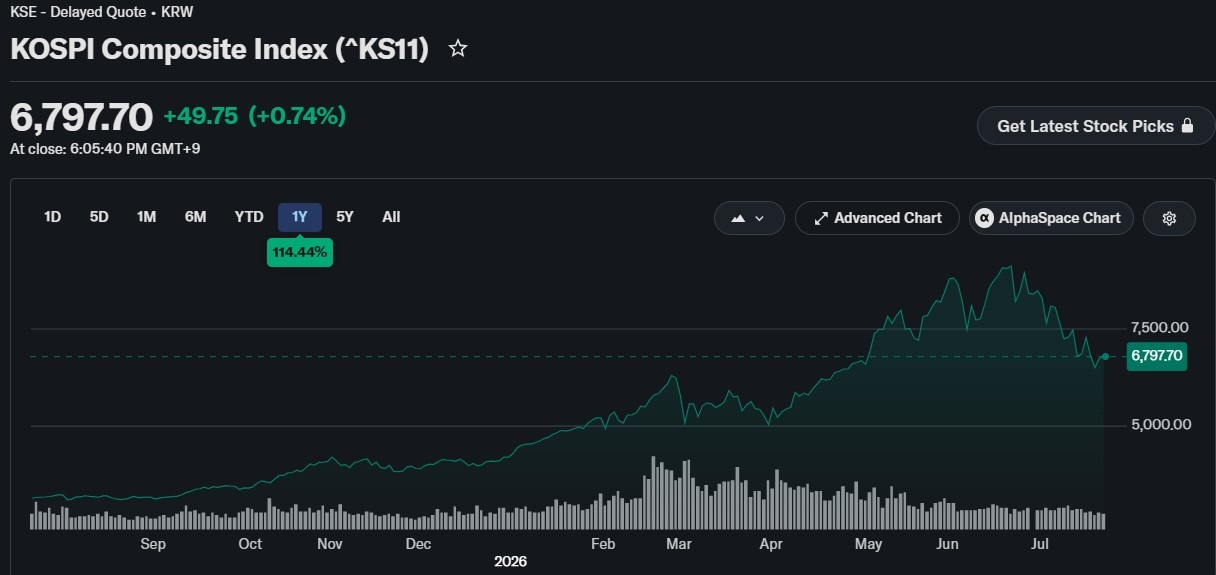
Korea Composite Stock Price Index’s one-year chart. Source: Yahoo Finance
South Korea’s KOSPI rose 114.44% over the 12 months to July 22, according to Yahoo Finance data, even after retreating from its peak in June. The rally contrasts with shrinking activity on won-based crypto exchanges, suggesting retail investor attention is shifting toward equities.
Retail fatigue gives institutions room to step in
A Tiger Research report published on CoinGecko and updated on April 17 said that South Korea’s falling crypto activity reflects more than weaker prices. The report said recycled narratives and projects that failed to deliver contributed to investor fatigue, while the KOSPI rally gave retail traders more places to pursue returns.
Tiger Research said the widening gap between equity turnover and crypto volume did not necessarily mean that Koreans had lost interest in crypto, but rather that investors had more alternatives.
Related: South Korea eyes September launch for second phase of CBDC pilot: Report
The report described the market as in structural transition with retail investors stepping back while institutions move in. Banks and financial groups were positioning around won-denominated stablecoins, tokenized real-world assets (RWAs) and exchange investments even before legislation was finalized.
Tiger said institutional activity could be a healthy replacement for some of the retreating retail participation, although institutions were still finding their footing.
Magazine: Inside the ‘fake police raid’ that forced a $1M Bitcoin transfer
Cointelegraph is committed to independent, transparent journalism. This news article is produced in accordance with Cointelegraph’s Editorial Policy and aims to provide accurate and timely information. Readers are encouraged to verify information independently.














 English (US) ·