
 1 month ago
27
1 month ago
27
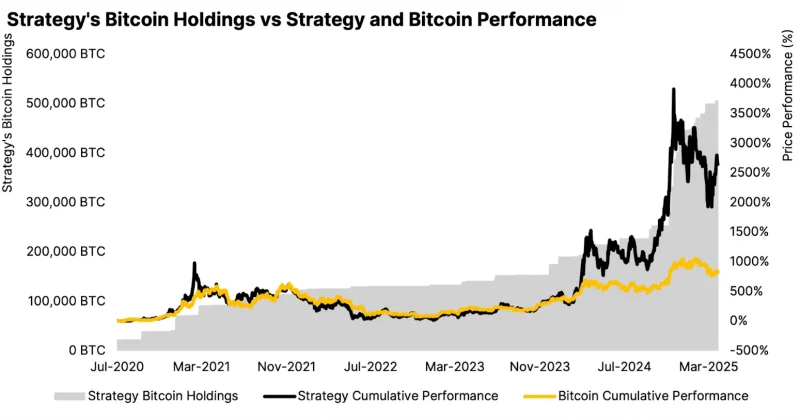
If you’ve been watching Strategy (formerly MicroStrategy) long enough, you know the company treats Bitcoin like a religion and tax optimization like a science. Now there are signals the firm may be gearing up for another round of tax-loss harvesting on its massive Bitcoin stash, echoing a maneuver it pulled off in December 2022.
The strategy is deceptively simple and, for now, perfectly legal. Sell Bitcoin at a loss to lock in tax benefits, then buy it right back. Traditional stock investors would get flagged by the IRS’s wash sale rule for that kind of move. But crypto isn’t subject to wash sale restrictions, which means Strategy can have its cake, eat it, and then buy more cake.
The 2022 playbook
Here’s what happened last time. On December 22, 2022, Strategy sold 704 BTC for approximately $11.8 million, at roughly $16,700 per coin. Two days later, it turned around and bought 810 BTC at approximately $16,800 per coin. It ended up with more Bitcoin than it started with, plus a realized capital loss it could use to offset future gains.
That’s not a typo. The company sold low, bought back at essentially the same price, ended up holding more coins, and booked a tax benefit. By late 2022, Strategy held around 132,500 BTC at an average cost basis of roughly $30,397, representing about $4 billion in total investment. It then picked up an additional 2,500 BTC on December 28 of that year.
The whole operation hinged on one critical detail: the IRS wash sale rule, which prevents investors from selling a security at a loss and repurchasing it within 30 days, applies to stocks and securities. Not to crypto. The IRS has not extended this rule to digital assets, which creates a window that companies like Strategy can drive a truck through.
How tax-loss harvesting actually works
Think of it like this. You bought a couch for $1,000 and it’s now worth $600. If you sell it, you’ve “realized” a $400 loss. In the investment world, that realized loss can offset capital gains you’ve made elsewhere, dollar for dollar. If your losses exceed your gains, you can even deduct up to $3,000 against ordinary income per year, with the rest carrying forward.
The math scales dramatically for a company holding billions in Bitcoin. A $10,000 loss, for example, could save roughly $2,000 in taxes at a 20% capital gains rate. Now multiply that logic across hundreds or thousands of Bitcoin purchased at various price points over multiple years.
The key is something called “specific identification” of tax lots. When a company holds Bitcoin bought at many different prices over time, it can choose to sell the specific lots that were purchased at the highest prices, maximizing the realized loss. Strategy’s treasury team would need meticulous documentation, tracking each purchase with its cost basis, date, and quantity.
And because there’s no 30-day waiting period for crypto, Strategy can repurchase immediately. No exposure gap. No risk of missing a rally while sitting on the sidelines. The tax benefit is real; the market risk is basically zero.
What to watch in 2026
The signals suggesting another round of this activity haven’t been confirmed by recent sales data. But the historical pattern is worth paying attention to, particularly as Q2 2026 approaches.
There’s a regulatory dimension that could change the calculus. Congress has periodically floated proposals to extend wash sale rules to digital assets. The Build Back Better Act in 2021 included such a provision, though it never became law. If legislators eventually close this loophole, companies like Strategy would lose one of their most elegant tax planning tools.
When the largest corporate Bitcoin holder sells coins, people notice. The 2022 sale generated headlines suggesting Saylor was “dumping Bitcoin,” when in reality the company ended up with more coins than it started with. Understanding that the sale is a tax optimization play, not a loss of conviction, is the difference between panicking and recognizing a non-event for what it is.
Disclosure: This article was edited by Editorial Team. For more information on how we create and review content, see our Editorial Policy.















 English (US) ·