
 1 month ago
28
1 month ago
28
XRP has struggled to generate sustained demand in recent weeks as broader crypto market conditions remain fragile and selling pressure continues to dominate sentiment. Price action has reflected a lack of strong buying conviction, with several analysts warning that further downside cannot be ruled out if liquidity conditions fail to improve. While volatility has moderated compared with earlier corrective phases, momentum remains weak, leaving traders cautious about the near-term outlook.
A recent CryptoQuant report highlights exchange reserve dynamics as a key framework for understanding current investor behavior. Monitoring the amount of XRP held on trading platforms can offer insight into whether market participants are preparing to sell or accumulate. Typically, a sharp rise in exchange reserves suggests investors are transferring assets onto exchanges, often signaling readiness to liquidate positions. Such movements can increase immediate market supply and contribute to short-term selling pressure.
Conversely, declining reserves on exchanges tend to indicate withdrawals into private custody or long-term storage solutions. This behavior usually reflects stronger conviction among holders and reduced willingness to sell at prevailing price levels. As a result, reserve trends can help contextualize whether XRP’s current weakness stems from distribution activity or a broader repositioning phase within the market.
The analysis indicates that this pattern is currently visible in XRP’s supply ratio on Binance, a metric that measures the share of the asset’s total circulating supply held on a specific exchange. Over the past ten days, the ratio has declined from 0.027 to 0.025, signaling a measurable reduction in XRP balances on the platform. In absolute terms, this translates to roughly 200 million XRP withdrawn from Binance during that period.
 XRP Ledger Exchange Supply Ratio | Source: CryptoQuant
Although exchange-level movements can sometimes reflect internal reallocations, major platforms such as Binance publicly disclose custody addresses, allowing analysts to differentiate operational reshuffling from user-driven withdrawals with reasonable precision. In this context, the scale and direction of the change point more convincingly point toward organic outflows rather than technical adjustments.
Such a decline in exchange-held supply often reflects a shift in investor positioning. XRP has corrected by approximately 40% since the start of the year, a magnitude that can attract longer-term participants seeking discounted entry points.
When investors withdraw assets from exchanges, they typically reduce immediate sell-side liquidity and signal a preference for private custody over active trading. Taken together, the data suggest that a segment of market participants may be accumulating XRP at current levels, positioning for potential recovery rather than preparing for near-term distribution.
XRP Price Struggles Below Key Moving Averages
XRP remains under sustained pressure, with the weekly chart showing a clear downtrend following the rejection near the $3.30–$3.50 zone seen in mid-2025. Since that peak, price structure has shifted toward a sequence of lower highs and lower lows, typically associated with weakening momentum rather than consolidation. The latest candles suggest XRP is attempting to stabilize near the $1.40 region, but conviction remains limited.
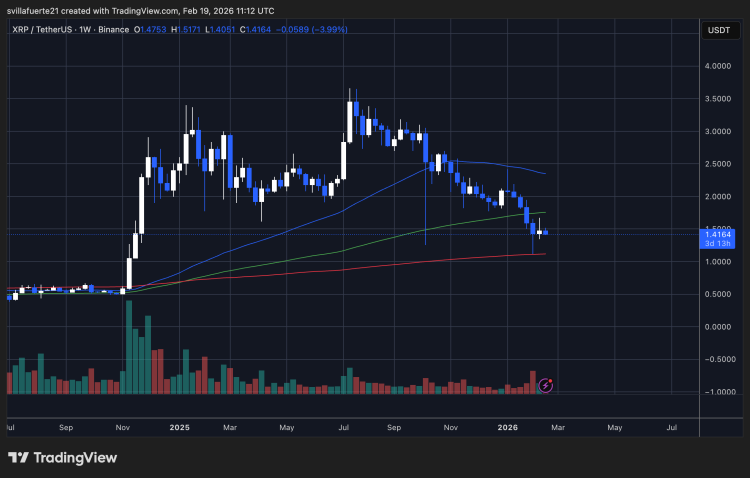 XRP testing key demand level | Source: XRPUSDT chart on TradingView
Technically, XRP is trading below the major moving averages visible on the chart, which now act as dynamic resistance. The shorter-term average has already rolled over, while the longer-term trend line continues to slope upward more slowly, reflecting the lagging nature of macro support. Sustained trading below these levels generally signals cautious sentiment and limited upside follow-through unless a decisive reclaim occurs.
Volume patterns also indicate reduced participation compared with the impulsive rally phase. This decline often reflects fading speculative interest, although it can also precede a base-building period if selling pressure exhausts.
From a structural perspective, the $1.30–$1.40 zone appears to function as immediate support, while the $1.80–$2.00 range likely represents the first significant resistance band. Until XRP reclaims higher levels with strong volume, the broader trend remains fragile and biased toward continued consolidation or downside risk.
Featured image from ChatGPT, chart from TradingView.com















 English (US) ·