
 1 month ago
33
1 month ago
33
Disclosure: The views and opinions expressed here belong solely to the author and do not represent the views and opinions of crypto.news’ editorial.
We began our new Outset Data Pulse analysis expecting 12 years of headline data to confirm a familiar belief in crypto: that news moves markets, and that faster headlines give you an edge.
But what the findings showed instead was more unsettling: most of the time, price seems to move first, and the headline comes later to explain it.
That’s not to say that “news doesn’t matter.” It’s closer to saying we’ve been treating it as the trigger when it often behaves more like the explanation after the move. And it’s easy to see why that belief survived for so long.
Anyone who spends enough time around crypto starts to notice the same thing: something moves, the news feed lights up, and then the dots get connected. When Bitcoin dumps or soars, coverage multiplies. When a major decision hits, whether it’s an ETF approval, an exchange collapse, or a legal victory, headlines also explode.
But the part of that belief which really matters – the part that turns news into a tradable edge – is directional. If headlines genuinely cause price movement, then reading faster makes you earlier. If price movement causes headlines, then reading faster mostly just makes you better informed about what already happened.
That was the real question here: not whether news exists in the sequence, but whether it consistently comes early enough to matter in the way traders often assume.
The part where the data got harder to argue with
The core dataset powering this Outset Data Pulse report includes 63,926 CoinDesk headlines spanning January 1, 2014 through December 30, 2025, matched to daily Bitcoin closing prices from the TradingView composite index.
That gave us 4,381 days where both a closing price and a headline count were available – enough to test the relationship from several angles, including causality, price behavior around major news spikes, headline sentiment, and topic clustering on the busiest coverage days.
It is also broad enough to cover nearly every “surely news mattered there” event worth testing, including bull and bear cycles, the FTX implosion, the COVID crash, and the start of the spot Bitcoin ETF era.
News volume didn’t forecast price
One of the first things we looked at was whether yesterday’s information helps forecast today’s movement.
We inspected five time horizons, from one day out through five days out. What kept standing out was that the news did not predict Bitcoin’s price across those lags.
Then there’s the kind of number you can’t really argue with because it’s too small to appear important: the correlation between daily changes in article volume and daily Bitcoin returns was 0.019, which means only 0.04% of daily price action was explained. For practical purposes, this is effectively zero.
The longer-term picture points in the same direction. Year by year, article volume and Bitcoin volatility moved on very different rhythms, with no stable relationship between heavier coverage and more explosive price behavior.
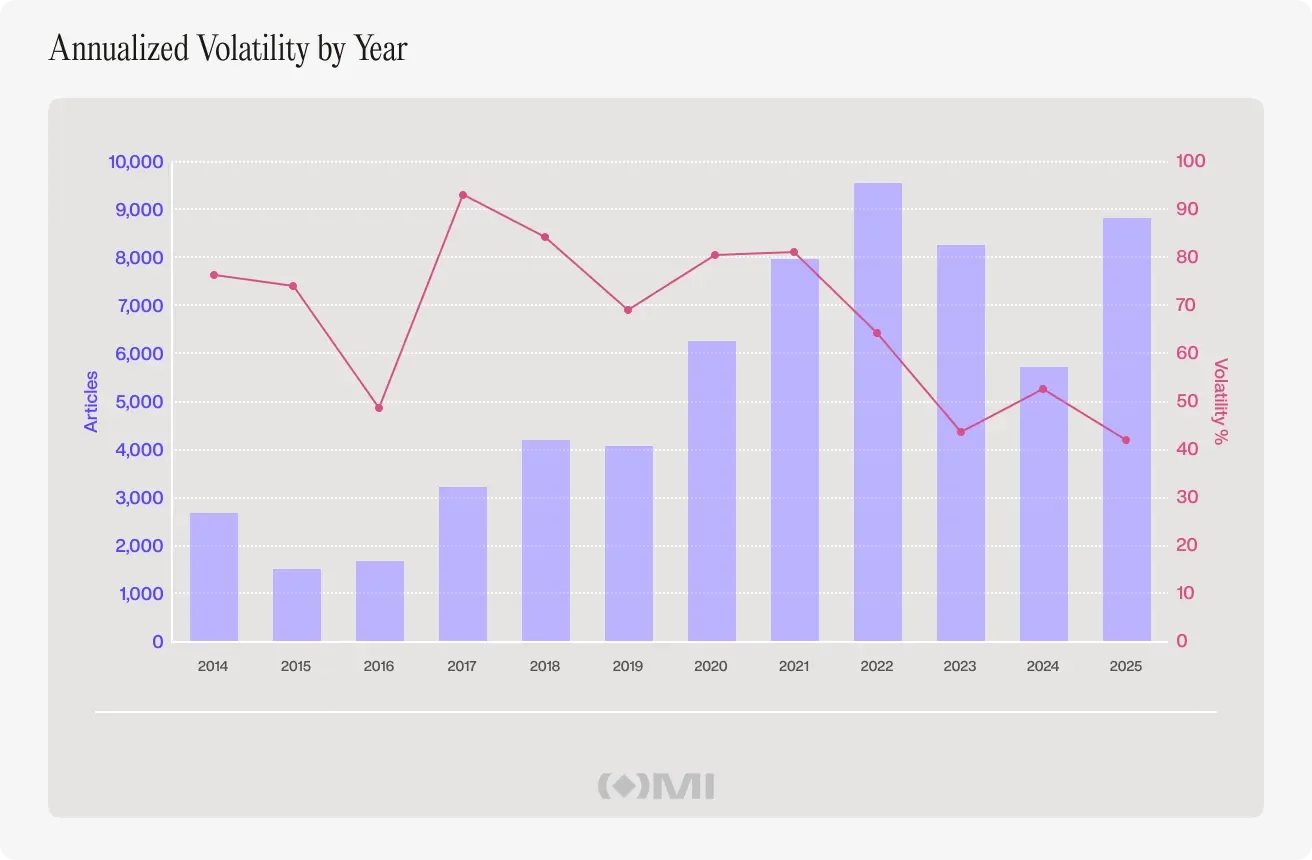 Image Source: Outset Data Pulse
That doesn’t mean news and volatility never overlap. They obviously do. But over time, the relationship stays too loose and inconsistent to treat headline volume as a dependable signal on its own.
Price started showing up before the coverage
We also looked in the reverse direction: whether price moves tended to show up before headline volume did, and the most interesting pattern appeared around a two-day lag.
But the part that felt closest to actual market experience was looking at the 50 biggest news days and tracking Bitcoin’s price three days before and three days after each spike.
What stood out was the shape of the move. In the three days before a major coverage spike, Bitcoin’s price was already elevated, around 1% above the event-day baseline. Then after the spike, price drifted down by roughly 0.8% by day three.
That is not a “news moves markets” narrative. It’s a “markets move, then news catches up” story. And once you see that shape, you start noticing how many famous crypto moments feel like they rhyme with it.
Even the biggest headlines didn’t behave like clean signals
These are the kinds of moments we all remember because they felt like turning points for crypto. For example, the U.S. Securities and Exchange Commission approved the spot Bitcoin ETF on January 11, 2024. CoinDesk published 51 articles that day while Bitcoin dropped 7.67% the next day and was down 10% by day three.
Compare that with December 4, 2023, when speculation was running hot but nothing had been confirmed. CoinDesk published 81 articles, and Bitcoin rose 5% the next day.
The same inconsistency showed up elsewhere: after the FTX collapse produced the busiest news day in the dataset, Bitcoin barely moved, while the January 2017 break back above $1,000 was followed by an 11% drop the next day and nearly 20% within three.
Across the ten biggest news events in the dataset, price reactions never settled into a usable pattern – some produced strong gains, others sharp losses, and many no clear follow-through at all.
That inconsistency matters because it’s what breaks the tradability story. If “news moves markets” were a stable indicator at the daily level, the largest news spikes would be where you’d expect the relationship to show up most clearly, certainly not where it dissolves into randomness.
We tried sentiment too
At that point, the obvious pushback is that volume is noisy, but sentiment might still hold the edge. Surely, bullish vs bearish headlines should matter, right?
So every headline was run through FinBERT, a financial-language sentiment model. It labeled each headline as positive, negative, or neutral. It also averaged sentiment across each day.
The dataset’s distribution was nearly perfectly balanced, with 58% neutral, 21% positive, and 21% negative. The part that matters for trading is the next step: did daily headline tone correlate with daily returns?
The reported correlation was 0.07, with sentiment explaining about 0.5% of price movement. Again, this is close to nothing for anyone trying to systemically time entries. Worse (or maybe more revealing), the relationship wasn’t stable. In rolling three-month windows, the correlation flipped between positive and negative with no consistent pattern.
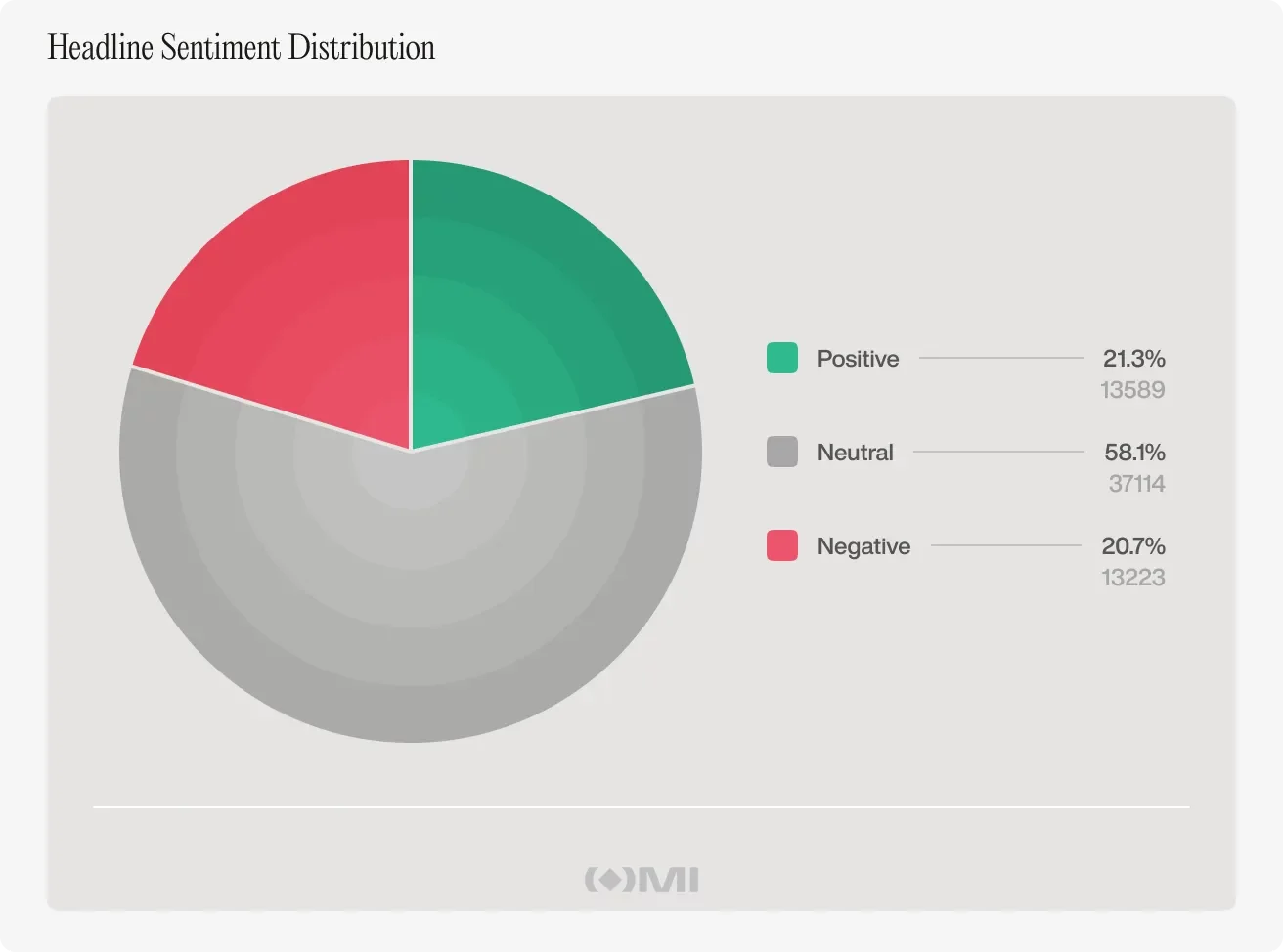 Image source: Outset Data Pulse
There’s also something that feels obvious once you say it out loud: headline sentiment can end up ‘grading’ language that is already racing to price. A headline like “Bitcoin falls below $70,000” gets a negative score, but the fall is already in the same day’s price data.
So we’re back in the same place: the headline is describing the move, not front-running it.
The reframing that made everything make sense
None of what we have seen so far lands in the “ignore news” category. That’s not true, and it’s not useful.
The more hopeful shift is this: by the time a headline hits a major publication, the information has often already moved through faster channels. This includes order flow, on-chain data, social layers, insider networks, and other forms of positioning and interpretation that don’t wait for editorial cycles.
That’s the line that changes how we read the market. The media isn’t where the signal starts. It’s where the signal becomes legible. Headlines are pretty much the “last mile,” representing the moment when a move that has already begun gets named, packaged, debated, and turned into a story people can repeat.
What this changes
Reading faster doesn’t necessarily make you earlier. The market absorbs information before the newsroom has even agreed on the framing. Headlines are often better at telling us what just happened than what happens next. That’s not an insult to journalism. It’s a statement about timing.
And using media as a timing tool can put you behind the market, because the thing you’re reacting to may already be reflected in flows and positioning by the time you are ready to move.
Even the report puts it plainly: headlines are not a clean signal feed. On peak-coverage days, about 61% of headlines fell into broad industry noise – partnerships, fundraising, product launches, stablecoin developments, NFT and gaming updates – with no obvious link to Bitcoin’s next move. Even regulation, the strongest plausible category, still failed to produce a reliable signal at the daily level.
One of the stranger findings was that even Bitcoin halving did not emerge as a distinct cluster on extreme-news days, suggesting that some of Bitcoin’s most important forces do not operate through the daily headline cycle at all.
Where we have to be honest about the exceptions
News could matter at much shorter timeframes, specifically minutes rather than days. A breaking headline can still move the market in the moment, even if that effect gets muted once you zoom out to daily closing prices.
At the same time, longer and slower narrative shifts, the kind that build over weeks, may still influence price in ways this approach can’t fully capture.
There are limits to this too: one publication, even a highly trusted one, does not represent the whole information universe. Crypto’s fastest information often travels through social platforms and private channels that this dataset can’t track. Also, some patterns may only show up in specific conditions, not in the cleaner daily relationships these tests can pick up.
So we’re not left with a simple “news is useless” mantra. Rather, we’re left with something more actionable: most of the time, the headline is the market becoming explainable, not the market beginning to move.














 English (US) ·