
 1 month ago
30
1 month ago
30
The landscape of digital assets in 2026 is unrecognizable from the "wild west" era of a few years ago. While Bitcoin has reached psychological milestones above $70,000, the broader ecosystem of independent crypto projects is struggling for air. The "hidden truth" behind this stagnation isn't just a lack of funding; it is a fundamental shift in who the market is built for.
The 2026 Stagnation: A Market in Transition
As of March 2026, the crypto industry is grappling with the aftermath of the late 2025 "liquidity flush," which saw over $20 billion in leverage wiped out in a single month. This event, often called the 2026 Crypto Crisis, forced a pivot from speculative retail-driven growth to a more rigid, institutional-grade structure.
Recent data suggests that while the $Bitcoin price remains resilient due to ETF inflows, nearly 80% of new blockchain startups fail within their first year. The era of "launch now, fix later" has been replaced by a "stagnation" where projects simply cannot gain traction without massive corporate backing.
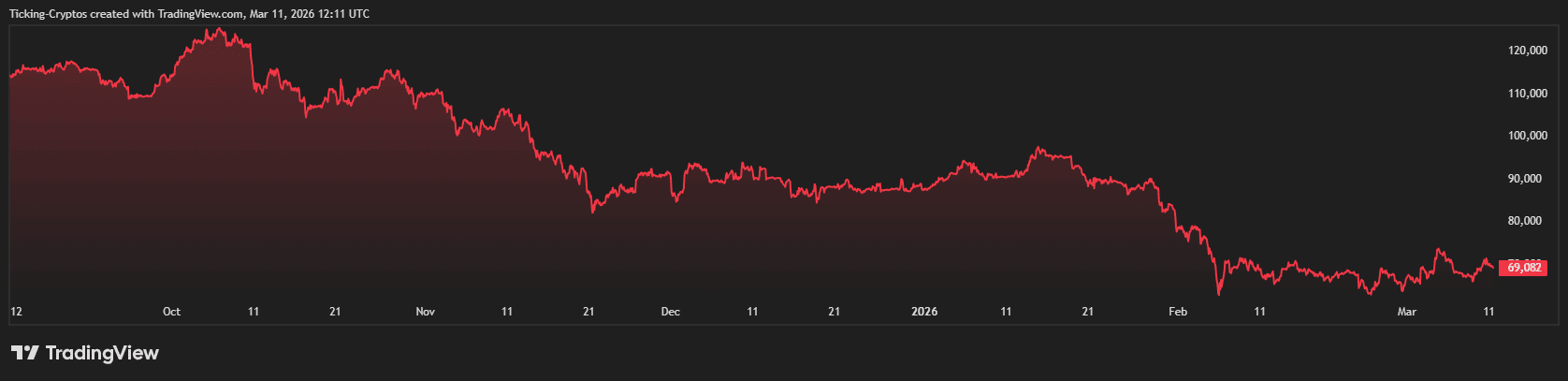 Bitcoin price in USD over the past 6-months crashing ~40%
1. The Death of Retail "Degen" Culture
The most visible reason for project failure in 2026 is the Retail Investor Exodus. For years, small-scale investors fueled the fire of decentralized finance (DeFi) and NFTs. Today, that fire has dimmed for three primary reasons:
- Aversion to Leverage: After the 2025 crash, retail traders have largely moved their capital back to traditional equities or "safe-haven" assets like tokenized gold (XAUT).
- The Yield Trap: Regulatory crackdowns on stablecoin interest, such as the proposed Digital Asset Market Clarity Act in the US, have made it harder for independent protocols to offer the "passive income" that once attracted millions.
- Institutional Domination: Retail participants now feel like "exit liquidity" for Venture Capital (VC) firms. Most new tokens launch with "low float, high FDV" (Fully Diluted Valuation), leaving no room for retail profit.
2. The MiCA Effect: Compliance as a Barrier
In Europe, the full implementation of the Markets in Crypto-Assets (MiCA) regulation has been a double-edged sword. While it provides a professional exchange environment, it has effectively priced out the "garage developer."
"MiCA's licensing costs and rigorous whitepaper requirements act as a filter. It weeds out scams, but it also smothers the small, innovative teams that don't have $500,000 for legal compliance." — Industry Insight, March 2026.
Startups are now forced to choose between expensive compliance or operating in "offshore" shadows that institutional capital—and savvy retail—will no longer touch.
3. Corporate "Colonization" of Web3
The hidden truth of the 2026 stagnation is that crypto technology is succeeding, but crypto "projects" are failing. Big banks and corporations have successfully "unbundled" blockchain. Instead of using public, decentralized protocols, they are building private, permissioned versions of the same tech.
- Asset Tokenization: Real World Assets (RWAs) are moving onto the blockchain, but they are managed by entities like BlackRock and Goldman Sachs, not decentralized DAOs.
- Stablecoin Utility: Stablecoins have become the "Internet's dollar," yet the market is dominated by centralized issuers who work closely with central banks.
4. Technical Debt and "Zombie" Chains
Thousands of projects are currently "mostly dead" because they were built on foundations that cannot scale or lack a real use case. Many 2021-era blockchains have become "Zombie Chains"—networks with high theoretical value but zero organic traffic. The market is currently undergoing an aggressive consolidation where only 5-10 major "hub" chains will likely survive.
| High Regulatory Costs | Shutdown of small-cap startups |
| Institutional Pivot | Funding shifted to RWA and Infrastructure |
| Retail Fatigue | Lack of community engagement and "HODLing" |
| AI Integration | Obsolescence of non-AI-compatible protocols |
Is There a Way Out?
The stagnation of 2026 isn't the end of crypto; it is the end of the "hobbyist" era. Projects that survive this period are those that prioritize Sustainable Revenue over token inflation and Real-World Utility over Discord hype.
It is up to creators, enthusiasts, small startups, and individuals to create and innovate more in this space. Only then, would we be able to see a new breakthrough in crypto and web3.
















 English (US) ·