
 1 month ago
32
1 month ago
32
The long-term value of XRP is increasingly tied to the development of the global financial infrastructure it was designed to support. Rather than relying on short-term price speculation or fixed adoption timelines, XRP was designed to operate at the plumbing level of global finance, where adoption depends on regulatory clarity, institutional integration, liquidity depth, and real transaction flow. These systems are built quietly, tested extensively, and activated only when reliability is proven.
Why Financial Infrastructure Comes Before XRP Mass Adoption
XRP’s journey has never been hitting precise timestamps on the chart, because utility does not operate on a calendar. An analyst known as ChartNerd on X has revealed that the journey to $27 has been a projected path for years, and based on a stack of multiple Fibonacci time maps and extension targets, the road to 2030 is where the vision fully aligns.
ChartNerd argues that what the market is witnessing right now is the groundwork for the foundation-building phase led by Ripple, following regulatory clarity from the US Securities and Exchange Commission (SEC). This phase includes expanding institutional infrastructure, banking charters, and ETF inflows, all of which require time to scale before translating into measurable price impact.
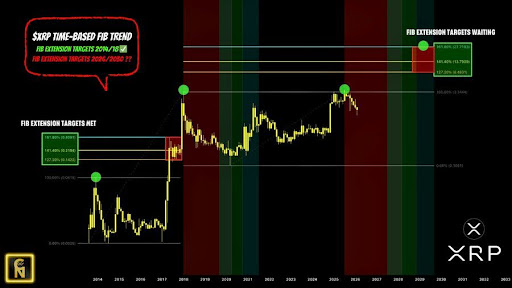 Source: Chart from ChartNerd on X
In that context, the short-term noise might fluctuate about the price action. However, the macro trend for XRP points toward progressive valuation milestones of $8, $13, and ultimately the $27 zone targets as the global settlement adoption scales. This thesis is not about timing individual candles, but about a structural shift towards 2030, where utility-driven value overtakes market speculation.
How The XRP Ledger Becomes A Safe Infrastructure To Integrate
The passing of the Clarity Act would mark a decisive turning point for XRP. A crypto analyst known as Bird on X has noted that the leading altcoin already has a unique level of legal clarity due to prior court rulings that confirmed it is not inherently a security when traded on secondary markets, an advantage most digital assets are still waiting to acquire.
According to Bird, the Clarity Act would move a step further by establishing a defined regulatory framework for digital assets, especially how they are classified and used, removing uncertainty for institutions, payment providers, and large-scale capital allocators. Once the rules are written into law, the biggest barrier, which is regulatory hesitation, will no longer sit in the background of every integration decision.
With regulatory hesitation reduced, broader adoption can accelerate, liquidity will deepen, and real utility can finally scale at speed, because companies can now gain the confidence to build on and integrate the XRP Ledger (XRPL) without worrying about sudden rule changes.
Featured image from Adobe Stock, chart from Tradingview.com















 English (US) ·